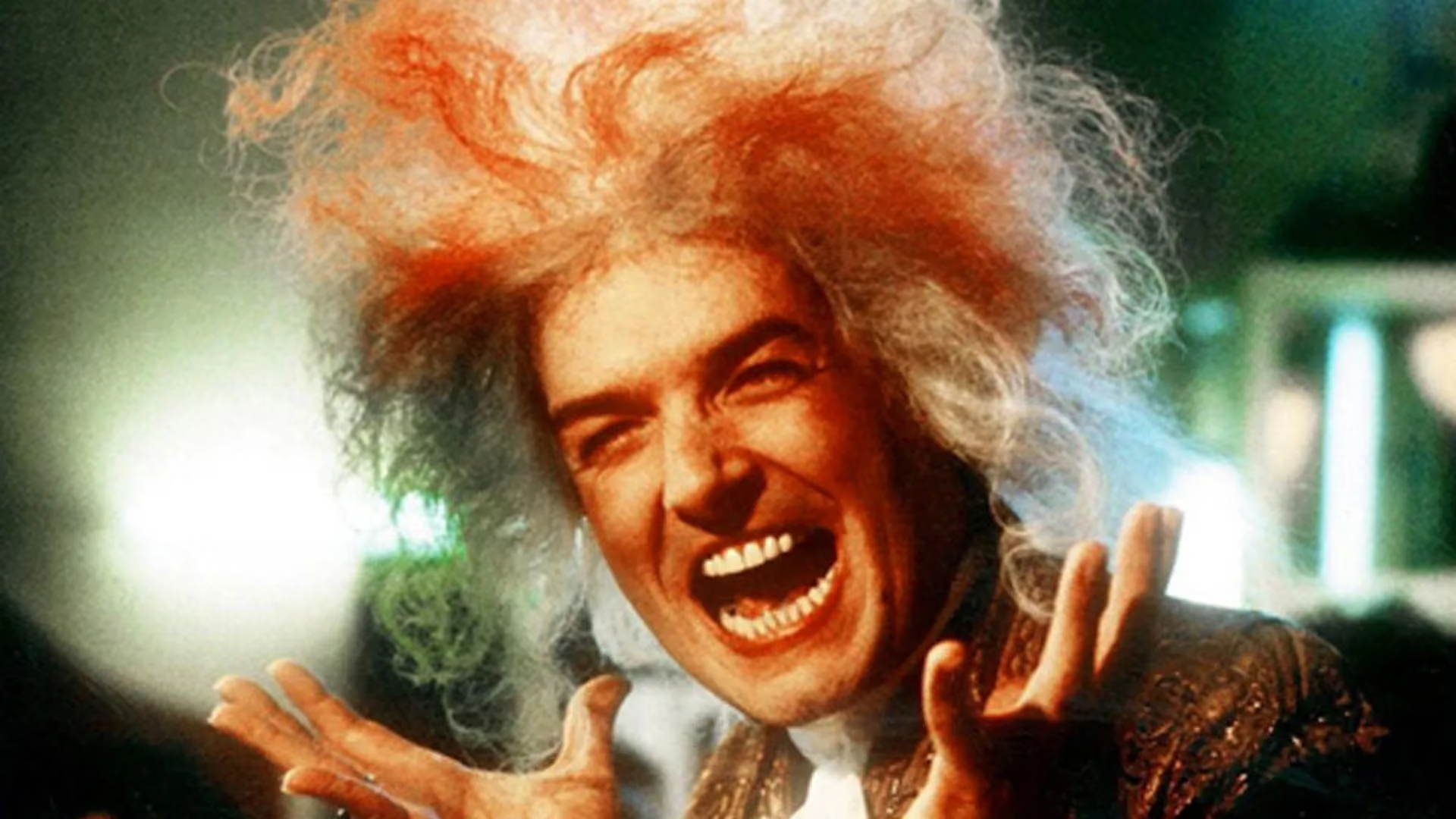
In 1985, Austrian musician Falco scored a huge international hit with the pop song Rock Me Amadeus.
Inspired by the 1984 Academy Award winning film, Amadeus, about the life of prolific classical composer, Wolfgang Amadeus Mozart, Falco’s music video imagines Mozart’s return as a modern day rock god.
He appears to be living the high life, loved and celebrated the world over by the rich and famous, all hungry for the new music that will turn them into superstars.
According to Illuminati whistleblower Donald Marshall, the music video accurately portrays his bizarre double life as a top-secret songwriter for the privileged elite of the New World Order.
He claims that he wrote Rock Me Amadeus, as a 10-year-old kid trapped at the cloning center, where “Amadeus” was one of his many nicknames.
The video depicts the constant demand for new music there, where his songs launched many a successful career.
“You don’t know it,” he says, “but you’ve been listening to me for over 40 years…”
Marshall came forward in late 2011 to speak out about the Illuminati’s use of top-secret human cloning technology which, he says, is much more advanced than the public is told.
He states that this top-secret tech allows members of the Illuminati to transfer their individual consciousness during the natural REM stage of sleep to their identical clones stored in a deep underground military base.
There they sit in the stands of a large sports arena to discuss global politics, plan future events and watch disgusting things done to innocent people, while their real bodies are at home sleeping.
Marshall has attended cloning since childhood, he says, as an unwilling participant in covert government projects.
Marshall explains that after displaying an early success at songwriting, he was brought to the cloning center night after night, in order to produce new music for such 80’s artists as Whitney Houston, Tina Turner, Madonna and many, many others.
Standing alone in the dirt pit of the arena, Marshall says he would just sing out song after song.
It was weird how he could do it, Marshall says, could easily create a new song out of thin air.
Marshall’s first song, entitled Lady, recorded by American country artist Kenny Rodgers, became a chart-topping hit, reaching #1 on Billboard magazine’s singles charts for 6 straight weeks just months later.
He says his next songs all went on to become Top Ten hits… all of them.
Before long, Marshall’s reputation grew and everyone wanted to meet the “Amazing Song Boy”.
Marshall tells us he doesn’t write songs down, but just “sings ’em out”, making it up as he goes, in the dirt arena of the cloning center, sometimes stopping for a moment to think up the next line or verse.
Marshall states that his songs would be recorded and then given to other songwriters to claim credit.
One can only imagine the experience of sitting in the darkly-lit arena of the cloning center, watching, waiting as Marshall creates new music on the spot, knowing that his songs are a guaranteed hit, that just one of his songs could make or break your career, one song could change your life forever… Who’s gonna get it?
Marshall explains that sometimes he would sing out a random song, and a celebrity would claim the song, saying that it sounded like something he’d sing.
Other times, he was asked to write custom songs for a specific artist or group, in which case, he had to write the song with their signature sound in mind.
But, he says that it’s not just about making music, it’s about making music that sells.
Through decades of trial and error, Marshall developed an uncanny ability to predict the music that people will like, and most importantly, people will buy.
His songs have made many millions of dollars for major record labels, musical groups, artists and bands the world over.
He had to make songs that were successful, because if a song failed, he would be blamed and tortured later as punishment.
Marshall says that now he doesn’t even like listening to music, because of bad memories of how he had to sing for his life for so many years.
What’s more, he finds that he can’t lose himself in the sound, but instead is always thinking: Will it sell?
In song making, Marshall explains that the melody is key in creating hit songs. He has learned that people want a catchy tune with some repetition, as we psychologically crave listening to music with a repeating pattern of rise, climax and fall.
Marshall tells us that he also likes to add familiar melodies from nursery rhymes and children’s songs in his music, as he has found that listeners will unconsciously remember the sound from their childhood and want to hear the song again and again.
Marshall points to the 2012 hit single Somebody that I Used to Know that he wrote for Australian singer-songwriter Gotye.
He explains that the song opens with a simple melody played on xylophone that he lifted from the nursery rhyme Baa Baa Black Sheep.
Marshall says that everyone subliminally remembers this familiar melody, although they won’t consciously make the connection.
This technique worked as the chart-topping hit went on to receive both critical and commercial success, selling more than 13 million copies worldwide, to become one of the best selling singles of all time.
In fact, Goyte co-manager John Watson said, “We’ve never seen any song make a deeper or more immediate connection with so many people.”
Marshall explains that using techniques like this helped him sell many records and kept him from facing torture… most times.
Even though Marshall’s work has received numerous awards, honors and accolades over three decades, he has yet to receive any public recognition.
For example, Gotye won two Grammy Awards in 2013 for hit single Somebody that I used to Know for Best Pop Duo/Group Performance and Record of the Year.
And as for Marshall receiving any financial compensation for all the many millions his music has made in the last three decades?
Well, let’s just say, he’s still waiting on that first check…
For example, Marshall’s first song Lady, written at the age of 5, has been singer-songwriter Lionel Richie’s most profitable song ever.
Richie, who was given songwriting credit for the ballad, told Entertainment Weekly that he has an “estate that Lady bought”.
In fact, one might say Marshall is the “most famous man you’ve never heard of”.
So, what songs does he claim to have written in his over 30 year career as a secret Illuminati songwriter?
As he says, just turn on the radio…
Music industry insiders know that while they may have many talented performers under contract, ready for stardom, their careers go nowhere without that one catchy hit single that receives massive airplay on the radio, driving consumers to download and buy.
Because, even with talent and a fan base, singers still need that crucial hit song to launch their careers and keep them afloat.
But that was never a problem with the kid onboard.
Marshall says he’s forgotten more songs than he can remember making over the three decades he’s been trapped there, writing music.
Marshall claims that his ability to create instant hits launched the careers of such 80’s superstars as Madonna, Whitney Houston, and Michael Jackson, all of whom were massively successful, with their music videos becoming a permanent fixture on MTV, gaining them a worldwide audience.
He says he remembers when Madonna was first introduced at the cloning center, having been discovered by Sean Penn as a dancer at a New York City strip club.
Penn saw her potential and requested she be brought to the cloning center, to meet other members of the Illuminati.
Marshall maintains that, in the beginning, he wrote all of her songs, (Holiday, Borderline, Lucky Star, Like A Virgin, Papa Don’t Preach, etc.), songs that went on to top charts around the world.
In fact, by 1989, Madonna was named Artist of the Decade by a number of recognized industry sources.
Whitney Houston became the second best selling female artist of the 1980’s, second only to Madonna, with her debut album becoming the best selling debut album of all time.
Houston was the first and only artist to chart seven consecutive No.1 songs on the Billboard 100, all songs Marshall created specifically for her at the cloning center (You Give Good Love To Me, Saving All My Love For You, How Will I Know?, etc.).
Marshall remembers Houston as being nice at first, however, in time she changed as she increasingly turned to drugs and alcohol to cope with the depravity she encountered at the cloning center every night in her so-called “dreams”.
Music industry insiders soon realized that Marshall’s music had the power to launch even big stars into superstardom, as in the case of the late King of Pop, Michael Jackson, who Marshall remembers well over his years at the cloning center.
Already enjoying the critical and commercial success from his 1979 solo album Off The Wall, Jackson’s follow-up album, Thriller, released several years later, would become and currently remains, the best selling album of all time, with an estimated sales of 65 million copies worldwide.
Thriller was the first album to have seven Billboard Hot 100 top 10 singles, including Billie Jean, Beat It, and Wanna Be Startin’ Somethin’ and won a record-breaking eight Grammy Awards in 1984, including Album of the Year.
And even though Jackson is given songwriting credit for four songs on the album (Billie Jean, Beat It, Wanna Be Startin’ Somethin’, and The Girl Is Mine). Marshall claims that he actually wrote those songs for Jackson at the cloning center.
Marshall says he remembers Jackson and his entire family well, where he says the Jacksons were privileged members.
Marshall says he has to laugh at the late singer’s reputation as a truther desperate to expose the Illuminati, when actually he says Jackson was “totally down” with them, and was not at all like his carefully crafted public image.
What’s more, Jackson’s 1996 hit single They Don’t Really Care About Us is his song, that Marshall says he wrote to alert the public about how the world elite really feel about you and me.
Marshall’s music not only created new superstars, his songs also supplied fading talent with powerful comeback careers, as in the case of the Queen of Rock ‘n’ Roll, Tina Turner, who launched a major comeback in the mid-80’s with the release of her 1984 solo album Private Dancer.
The lead single What’s Love Got To Do With It won three Grammy Awards that year, including Record of the Year.
Quickly recorded in London in just two months, Private Dancer became a world-wide success.
What’s Love Got To Do With It reached the top ten within weeks and, two months later, reached number one on the Billboard Hot 100 in the U.S., selling over twenty million copies worldwide.
While Turner brought her powerful vocals and electric stage presence, Marshall provided the tunes (What’s Love Got To Do With It, Private Dancer, Better Be Good To Me, etc.).
Another comeback kid, the late pop legend David Bowie, enjoyed massive mid-career success thanks, in part, to Marshall.
While known for decades as an innovator in music, art and design, Bowie had yet to write the pop song that would top charts in the U.S. and around the world.
Enter Marshall, who supplied the title track, Let’s Dance, the hit single, Modern Love, as well as a remix of China Girl for Bowie’s 1983 album, Let’s Dance.
The title track became an instant hit, reaching No.1 in the U.S., U.K. and around the world, while Modern Love and China Girl, both reached No. 2 in the U.K., all courtesy of Marshall.
Let’s Dance has sold 10.7 million copies worldwide, making it Bowie’s best-selling album.
Let’s Dance was nominated for the Album of the Year at the 1984 Grammy Awards, but lost to Michael Jackson’s Thriller.
With his career revitalized, Bowie traveled the globe with the sold-out Serious Moonlight Tour, emerging as one of the most important artists of the day.
The success of the album surprised Bowie, who later attempted to write his own catchy pop songs with the follow-up albums Tonight (1984) and Never Let Me Down (1987), which critics dismissed.
Unable to duplicate the success he had found using Marshall’s songs, Bowie returned to writing his own songs, experimenting with a wide variety of musical styles.
Not only did Marshall’s music launch new careers and relaunch those not-so-new, his songs also guaranteed success, reassuring for the Illuminati-backed music industry, known for playing it safe musically and distrustful of anyone willing to take chances.
For example, take the case of the late legendary singer-songwriter Prince and his neo-psychedelic album Around the World in a Day, released just one year after the 1984 mega-hit, Purple Rain.
The new album reflected important steps in Prince’s musical evolution, incorporating new instruments and musical styles which prompted critics to draw numerous comparisons to The Beatles’ Sgt. Pepper’s Lonely Hearts Club Band.
However, the record-buying public didn’t respond well to Prince’s new sound, resulting in a dramatic record sales drop, from 13 million sold for Purple Rain to only 2 million sold for the new album.
The only song on the album still remembered today, is the successful hit single Raspberry Beret, a popular song that quickly reached number two on the Billboard Hot 100, and was played at every Prince concert thereafter.
At the time, critics commented that the sound of the song was different than any previous Prince track, with the incorporation of international instruments and middle eastern percussion cymbals.
Marshall claims that Raspberry Beret is his, that he co-wrote with Prince, guaranteeing the album at least one hit single.
Marshall explains that many of the songwriters for whom he provided music are actually bitter by the fact that Marshall’s songs are usually the most popular tracks on any album, always the most requested and loved by fans.
Marshall contends that his music was not only used to create new superstars, his songs provided the jet fuel to launch new musical movements, such as the so-called Second British Invasion of the U.S. of the 1980’s.
One might say that this Invasion’s first lethal attack took the form of a single entitled Don’t You Want Me by British synthpop band The Human League from their album Dare.
This song, written by Marshall, about the failed romance between a man and a cocktail waitress-turned-superstar, was released in early 1982, and by July, hit No.1 on the Billboard Hot 100, where it stayed for three solid weeks.
Scores of British synthpop groups followed such as the Eurythmics, Culture Club, Duran Duran, Wham!, Billy Idol, Tears For Fears, as well as the post punk rock sounds of The Police, U2, and the popular mega-hits of Phil Collins.
Marshall remembers meeting these artists at the cloning center and claims to have written all of their biggest hits.
He explains that musicians like Collins, Sting, and Bono are loyal Illuminati members and favorites of the Queen, who would reward faithful service with guaranteed hits from Marshall.
He even wrote Peter Gabriel’s smash single Sledgehammer, he says, to describe an act of punishment he suffered at the cloning center using an actual sledgehammer.
Marshall claims that he wrote all of the hits for such synthpop stars as ABC, a-ha, The Cure, Depeche Mode, the Eurythmics, A Flock of Seagulls, Frankie Goes to Hollywood, New Order, Pet Shop Boys, Simple Minds, Soft Cell, Spandau Ballet, Thomas Dolby, the Thompson Twins, Ultravox and many more.
The mid-80’s also saw an international musical movement known as the “New Wave of British Heavy Metal”, where hard rock musicians from the U.K., infused the sound of heavy metal with the intensity of punk rock to produce fast, aggressive songs.
Two British heavy metal bands of the time, Def Leppard and Iron Maiden, are considered to be the most commercially successful and influential heavy metal bands of all time.
For example, Def Leppards’ 1983 album, Pyromania peaked at No. 2 on the Billboard 200 chart, just behind Michael Jackson’s Thriller, and sold more than six million copies in the U.S., turning Def Leppard into superstars.
Marshall claims that he wrote Pour Some Sugar On Me as a kid and, what’s more, states that he practically IS Def Leppard, and has written all of their popular songs, songs that are still heard on the radio every day some thirty years later.
Glam Metal bands also had a run of commercial success with Bon Jovi’s 1986 album Slippery When Wet topping the Billboard 200 and spending eight non-consecutive weeks there.
The single You Give Love a Bad Name, reached No.1 on the U.S. Billboard Hot 100 to become the band’s first number one hit.
Another successful group from that era was Guns N’ Roses who released the best-selling debut of all time, Appetite For Destruction, producing three top 10 hits including the No.1 Sweet Child O’ Mine, while Poison’s 1988 album Open Up and Say…Ahh! hit single Every Rose Has Its’ Thorn, sold eight million copies worldwide.
According to Marshall, he wrote all of those songs, while a trapped, scared teenager, yes, all of them…
The 80’s also saw a huge interest in heavy metal music, which Marshall says that he used to express his fury and rage at being caged at the cloning center, tortured nightly for new songs.
He says that his songs launched the successful careers of Metallica, Megadeth, Anthrax, Slayer, Queensryche, Quiet Riot, Cinderella, Twisted Sister and many more.
Marshall’s music also revived the sagging careers of established hard rocks bands such as Aerosmith, Alice Cooper, KISS, Black Sabbath, Scorpions and Whitesnake.
Over the years, Marshall claims to have provided songs for many heavy metal bands, such as Avenged Sevenfold, Motorhead, Disturbed, Lamb of God, System of a Down, Godsmack, Killswitch Engage, Tool, A Perfect Circle, Korn, Drowning Pool, White Zombie, Skid Row, Suicidal Tendencies, Linkin Park and many others.
The end of the 80’s saw the gradual decline of glam metal and the emergence of a completely new sound that came to be known as “Grunge”.
Originating in the city of Seattle’s active music scene, local guitarists fused elements of hardcore punk with heavy metal to create something raw and powerful, with lyrics that often spoke of social alienation, apathy, confinement and a desire for freedom.
By the early 1990’s, the music’s popularity had spread, with grunge acts performing in California and other parts of the U.S., building a strong following and leading to groups signing major record deals.
However, while professional scouts for the Illuminati-backed record labels signed many promising bands from the Pacific Northwest, they would still need those chart-topping hits to sweep the country and catch the attention of the mainstream consumer.
Marshall tells us that he was just a teenager when he met members from many grunge bands at the cloning center, where he wrote the signature hits for bands such as Pearl Jam, Alice in Chains, Soundgarden, Hole, and Stone Temple Pilots among others.
What’s more, Marshall says that he IS Nirvana, having written every one of their songs, even providing the name for the band.
While the late Nirvana frontman Kurt Cobain had a compelling voice and stage presence, Marshall says it’s really him you’re listening to, in every song.
He explains that musicians like Cobain, despite their reputation as songwriters, are more like performers that play music.
And while Cobain might have had the talent necessary to propel him to stardom, make no mistake, he got there on the strength of Marshall’s songs.
Marshall continued to provide the tunes for many alternative rock bands, such as Jane’s Addiction, the Red Hot Chili Peppers, Radiohead, R.E.M., The Smashing Pumpkins, Bush, Candlebox, Creed, Nickleback, 3 Doors Down, Silverchair, Beck, Counting Crows, Soul Asylum, Cake, Garbage, Rage Against the Machine and a decade later for bands such as No Doubt, Paramore, Train, and Imagine Dragons.
Marshall even supplied the music for Britpop groups such as Oasis, Muse, and Coldplay as well as the post-punk sounds of The White Stripes, The Killers, Green Day, and The Offspring.
Marshall maintains that many musicians secretly try to recognize his uncredited contributions to their successful careers.
He explains that the Foo Fighters’ 1998 hit single My Hero is not a tribute to “everyday, ordinary heroes” as former Nirvana drummer/Foo Fighers’ frontman Dave Grohl states.
Instead, Marshall says that Grohl wrote the song about him and that he provided songs for both Nirvana and the Foo Fighters.
Marshall also claims to have written many songs for U.K.’s britpop group, Oasis.
He says that Noel Gallagher is mean, and he had to laugh about the time that Gallagher famously criticized the work of Phil Collins, whose mega-hits dominated the music charts in the 80’s, calling Collin’s music “boring”, saying that it was “time for some real lads to get up there and take charge”.
Gallagher’s comment is especially ironic considering Marshall wrote all of Oasis’s best tunes and, incidentally, all of Collin’s biggest hits, as well.
Marshall says many singer-songwriters take credit for songs he wrote specifically for them, such as Mariah Carey, Adele, Norah Jones, Dido, Sarah McLachlin, Alanis Morrissette, Fiona Apple, Jewel, Natalie Merchant, Alicia Keys and Taylor Swift.
These so-called singer-songwriters are actually singing his songs, using his words, sharing his message.
Marshall claims that the Illuminati will recruit those of interest, and then bring them to the cloning center to meet him, so he can turn them into stars.
All they need to do is to find the performers, those with the right look and sound, while Marshall supplies the rest.
Marshall’s music launched the careers of such megastars as Mariah Carey, Janet Jackson, Britney Spears, Christina Aguilera, Justin Timberlake, Beyonce, Lady Gaga, Katy Perry, Taylor Swift, Justin Bieber, Rihanna, Adele, Usher, Pink, The Black Eyed Peas, Selena Gomez, Carly Rae Jepsen, Kelly Clarkson, Kesha, Avril Lavigne, Enrique Iglesias, Lana Del Rey, Bruno Mars and on and on.
Marshall says he’s written many of Britney Spear’s hits from the beginning, including her 1998 debut single Baby One More Time which became one of the best-selling singles of all time, reaching No.1 in every country around the world.
Marshall explains that the lyrics are not about the feelings of a young girl after a break-up with her boyfriend, but instead refer to the constant threat of punishment Marshall faces should he not produce successful songs… hit me, baby, one more time… indeed.
Over time, the Illuminati-backed music industry insiders became so confident that Marshall’s music could turn virtually anyone into a star, that they began to bring more and more to the cloning center to meet him.
Take, for example, international pop superstar, Lady Gaga, whose 2008 debut album, The Fame was a critical and commercial success around the world with its’ chart-topping singles Just Dance and Poker Face.
She followed that in 2009 with an extended play (EP) The Fame Monster, with its successful singles, Bad Romance, Telephone and Alejandro.
Her second full-length album Born This Way, released in 2011, sold over one million copies in its’ first week, topping the charts in more than 20 countries, with its’ No. 1 single Born This Way.
Despite her reputation as a songwriter, Marshall says he wrote every one of Lady Gaga’s songs from the beginning of her career. He says that all she brought was her arty costumes and hairstyles; Marshall supplied all the rest.
The same can be said for multi-Grammy Award winning singer-songwriter, Rihanna.
Marshall says he can remember when he first met Rihanna at the cloning center, fresh from the island of Barbados, eager to do whatever it took for fame and fortune.
Marshall claims to have written all of her hit singles, such as Umbrella, Take A Bow, Disturbia and Diamonds.
With sales exceeding 200 million records sold worldwide, Rihanna became one of the best-selling artists of all time, with 14 number one singles on the Billboard Hot 100.
Rihanna must have made many influential friends there, because Marshall says that, for a time, they just kept giving her every song he wrote, one after another.
Marshall explains that while some are brought to the cloning center to meet him, others have attended since childhood, as members of privileged Illuminati families.
He says they were selected as kids to be the next big thing, with their success guaranteed.
Even though these “cloner-kids” create fake bios filled with stories of how they struggled until they were discovered singing at local county fairs and coffee shops… don’t fall for it, says Marshall.
Truth is, they were favored from childhood to be big stars, as a reward to their Illuminati parents for years of faithful service.
Whether it’s pop, country, hard rock, heavy metal, electronica, hip hop, rap … you name it. Marshall simply writes the music that sells.
Marshall says that he’s known underground as the Rainman because of the untold millions of dollars his music pours into profits worldwide.
And as for that other Rainman, legendary rapper Marshall Mathers…?
Well, let’s just pretend he never picked up a pen… for according to Marshall, he is Eminem and has written all the rapper’s songs.
Marshall tells us that Eminem was promoted by the Illuminati in the late 90’s as a way to introduce black rap music to middle-class white kids across the country, which was then a lucrative, underdeveloped market.
Marshall says that at first he was writing songs for Miami-born white rapper, Vanilla Ice, who, with his 1990 hit single Ice Ice Baby became the second white rapper in history to top the charts.
His debut album To The Extreme, became the fastest selling hip hop album of all time, spending sixteen weeks at No.1 on the Billboard 200 selling over eleven million copies.
However, unlike New York white rappers the Beastie Boys, Vanilla Ice had no street credibility, and with overall negative reviews for his next two albums, interest in the rapper soon dropped.
Marshall maintains that music industry insiders were looking for a replacement for Vanilla Ice when they discovered Detroit rapper, Marshall “Eminem” Mathers, who had recently moved to Los Angeles in 1997 to compete in an annual nationwide battle rap competition.
Placing second, the Illuminati took notice and quickly recruited Mathers into their ranks, with promises of fame, fortune, and guaranteed success with the use of Marshall’s music.
Forget any official versions you’ve heard of Eminem as just another struggling young rapper pushing his demo CD before being discovered by Interscope Records founder, Jimmy Iovine and famed record producer, Dr. Dre.
Truth is, Mathers is “Illuminati made and paid”, says Marshall and adds that he’s “not the nice, cool guy everyone thinks he is”.
Thanks to Marshall, Eminem went on to become the best-selling hip hop artist of all time, with twelve No.1 singles worldwide, and eight No.1 albums on the Billboard Top 200.
In 2009, Billboard Magazine even named Eminem the “Artist of the Decade”.
Marshall says that he has written songs for many rappers such as Public Enemy, Run-D.M.C., Master P., OutKast, N.W.A., LL Cool J., MC Hammer, Snoop Dogg, Ludacris, the Fugees, Salt ‘N’ Pepa, the Beastie Boys, DMX, Jay-Z and many more.
Marshall says he even collaborated with the late rapper, Tupac Shakur, in writing his best songs.
Imagine if the public found out that their favorite ghetto anthems were actually penned by a white kid straight outta Halifax…
Marshall says that many rappers manufacture fake bios of growing up in “da ’hood” when, in reality, they were born to lives of wealth and privilege, selected for fame from influential Illuminati families.
Marshall reports that artists like Lil’ Wayne and Kanye West owe him a “chunk of change”, as he’s been writing most of their music since the very beginning of their careers.
For the over three decades that Marshall has claimed to been trapped at the cloning center writing music, he says that he made a “whole lot of bad people a whole lot of money”.
Marshall maintains that many at the cloning center are jealous of him and his talent for creating hit songs “outta nowhere, like magic”.
They say that it is unfair that they struggle for months to write one song with poor results, whereas Marshall can write a song in minutes that is guaranteed to sell millions of copies worldwide.
He remembers several years ago, one songwriter bragging about his big win for the “Best Record of the Year” that he won the at the Grammy Award ceremony the night before, a triumph he achieved using one of Marshall’s songs.
As the songwriter addressed the audience at the cloning center, and went on and on about his win, Marshall finally spoke up.
“Yeah,” he said, “But what did you do?”
“Well”, the songwriter quickly replied, “I play the piano…”
The crowd roared in laughter.
Marshall had made his point, although, he remembers, the songwriter punished him later for making the remark.
Marshall claims that in speaking out, he is not looking for fame or riches.
His only aim is to tell the public the truth about the top-secret human cloning that takes place in deep underground military bases around the world.
He says he will never stop until all those trapped there are freed and all cloning centers are shut down forever.