“No one has a story like mine,” says Illuminati whistleblower Donald Marshall.
Marshall came forward in 2011 to post online his eye-witness accounts of the serious crimes that take place nightly at deep underground military bases around the world, crimes including the sex trafficking and exploitation of young children in which elite members can indulge themselves without any possible chance of discovery.
Marshall has risked his life to speak out about the Illuminati’s use of top-secret human cloning, explaining that the science is much more advanced than the public is told.
Human cloning is not only possible, he says, but has been practiced for decades.
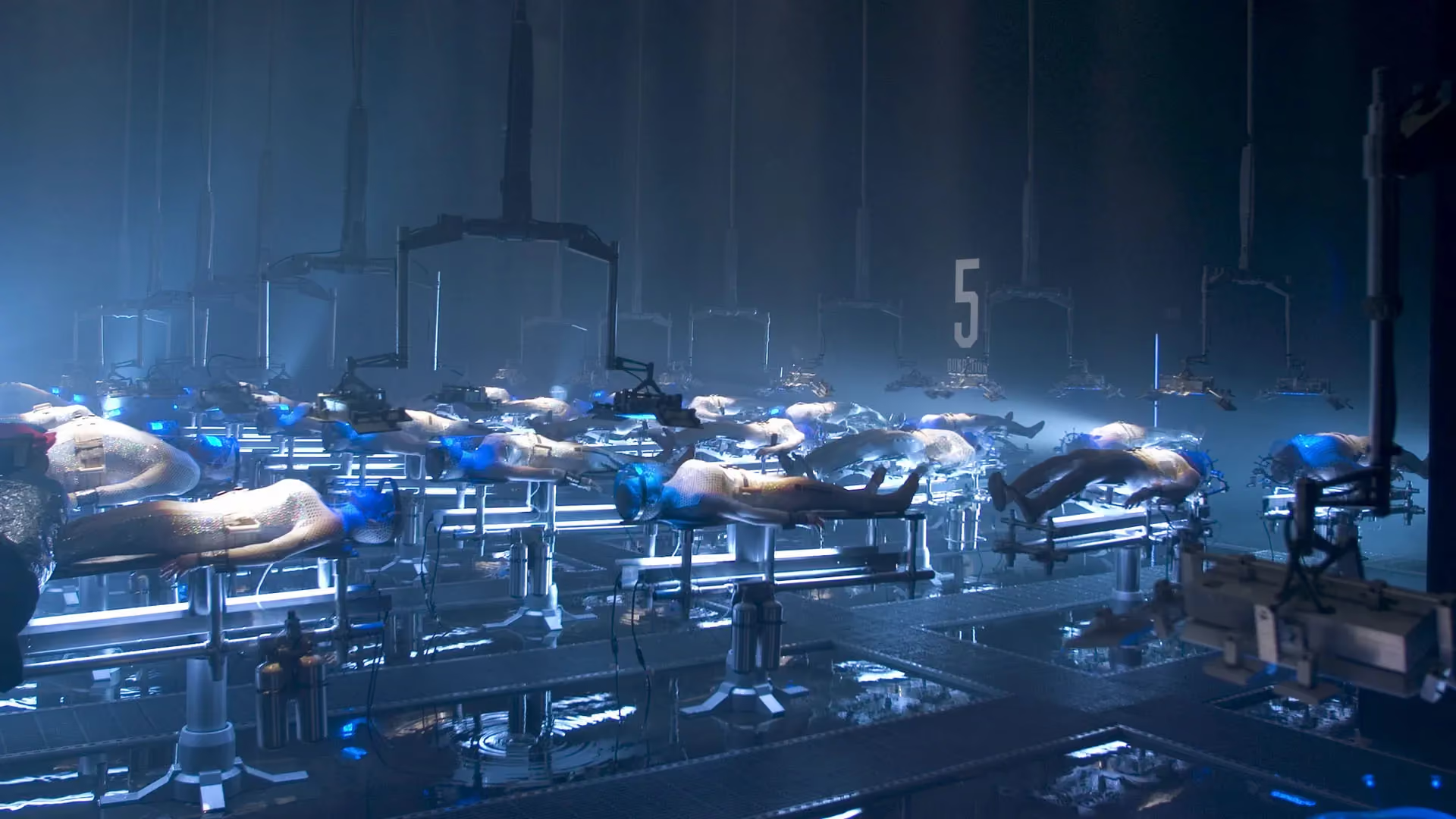
Known as REM-Driven Consciousness Transfer, Marshall says this technology is able to track, locate and then transfer an individual’s consciousness during the natural REM cycle of sleep to their identical clone stored at a cloning center many miles away.
By utilizing this top-secret tech, Marshall states that Illuminati members are able to meet as clones in deep underground military bases.
There they sit in the stands of a large sports arena to discuss global politics, plan future events and watch disgusting things done to innocent people, while their real bodies are at home sleeping.
When the real body wakes up, “all goes black,” says Marshall, as the clone body drops limp, while workers come to collect and store the deactivated clone until the next night.
Marshall claims to have attended these secret meetings with select members of the Illuminati since early childhood, as an unwilling participant in many covert government projects. While Marshall can relate in detail the events that took place at the cloning center every night, he reports that he could never remember how he got there, and as a child, thought that he had been abducted somehow.
Children are always in high demand there, says Marshall, explaining that the reason he was originally brought to the cloning center at age 5 was to service the members as a “diddle kid”, a child to be sexually used, abused and discarded in time.
Marshall wouldn’t learn until decades later that his family, while appearing “normal enough”, had strong Illuminati connections that went back for generations. He discovered that his own mother had been used there the same way when she was a young child. Now it was her turn to bring her own children to the cloning center in exchange for favors and benefits from other Illuminati members.
Marshall says he was memory suppressed until age 30, and would not consciously remember any of this until much later, when the elite decided it was time to mechanically release his memories to present consciousness, in what is known as “The Awakening”.
Marshall says in his earliest memory, he simply opened his eyes to find himself there, standing in the center of a mid-size indoor sports arena.
He says he thinks he was about 5 years old, although he admits that he might have been even younger.
Looking around, Marshall saw that he was surrounded by stands filled with people, sitting in the dark.
He says he had no idea of where he was or how he got there and, at the time, believed that he had been kidnapped in his sleep.
What Marshall didn’t realize was that he was not in his real body, but was activating a clone, which, according to Marshall, feels as real as real.
As he looked at them all, Marshall says all he could do is cry.
“I thought they were going to kill me,” he remembers, “I saw their faces.”
They asked him if he could do anything else, sing or dance perhaps?
With heart racing, Marshall began to scan the crowds, searching among those seated in the dark, desperately trying to think of a way out.
Sitting off to the side, he recognized Queen Elizabeth, complete with diamond tiara, accompanied by other members of the royal family.
Marshall began to sing an original song he created for her on the spot.
There in the bright lights he stood, a scared 5-year-old, serenading the Queen.
When Marshall finished, he remembers the silence that followed as the crowd sat in utter amazement.
“They’d never seen anything like it,” he says.
Marshall says the song was released weeks later, recorded by American country artist Kenny Rodgers, entitled Lady. The song immediately became a chart-topping hit, reaching #1 on Billboard magazine’s singles charts for 6 straight weeks just months later.
Marshall remembers being brought back there for more songs the next night, and the next and the next.
Standing alone in the dirt pit of the arena, Marshall says he would just sing out song after song. It was weird how he could do it, he says, could easily create a new song out of thin air.
He claims that his music was recorded and the songs given to different artists to sing. He says those songs all went on to become Top Ten hits…all of them. Before long, Marshall says that his reputation grew and everyone wanted to meet the “amazing song boy”.
Marshall reports that after his early success at hit-making, he was brought to the cloning center every night, where he joined a group of other talented children that had been selected to write music.
He remembers playing what they called the “make-a-song” game, with adults asking the children to think up rhyming words, etc. in order to produce new music. Marshall claims that he quickly surpassed them all, even though, at age five, he had a limited vocabulary and “needed help with the big words”.
He says that after about eight of his songs became chart-topping hits, the other children were intimidated by him and gave up trying to compete. Soon, they were bringing him on nights when there were no other children there, Marshall remembers, to create new music like magic and entertain the crowds.
Night after night, singing alone in the dirt pit of the arena, he created top-ten hits for such 80’s artists as Whitney Houston, Tina Turner, Madonna and many, many others. They called him “The Phenomenon”. But one day, Marshall claims he ran out of ideas. That’s when, he says, the nightmare began…
They began threatening to hurt him in order to scare a song out of him. Sometimes this would work, Marshall says, and, terrified, he would start singing out what would become the next hit single.
Other times, however, if he couldn’t think of an idea in time, Marshall would be severely punished. He says the threats turned into punches, slaps, and kicks, escalating to bizarre acts of torture. Marshall says the situation only got worse over time, with even the celebrities taking turns hurting him, in exchange for new songs.
With a never-ending demand for new music, Marshall says they began to hurt him every night, only stopping if he started to sing. He claims that they even began to experiment with different ways to punish him, all for the viewing pleasure of the privileged elite. Marshall says he became the “diversion between perversions”.
Marshall tells us that most are unaware that the Illuminati own nearly all news, media and entertainment outlets in the world.
With controlling interest in powerful multinational corporations, they own television networks, cable channels, movie studios, music labels, and most internet websites.
Marshall claims yearly profits from music and entertainment run in the millions.
Marshall reports that after his early success at hit-making, he was brought to the cloning center every night, where he joined a group of secret songwriters for the Illuminati.
There, these songwriters meet, while their real bodies sleep, and create the next big hits for a selection of musical artists. Marshall explains that making new music and songs are among the many activities that take place every night at top-secret cloning centers, in special recording studios built underground for this purpose.
Marshall says he’s forgotten more songs than he can remember making over the three decades he’s been trapped writing music there. He says he would sing a song from start to finish, complete with words and melody, in one take, in order to avoid punishment, and, as a reward, would then be deactivated and allowed to leave until the next night. For years, he would create a song a night, but sometimes they would demand more, three or even five songs before he would be released unharmed.
Marshall explains that his work is always credited to other songwriters, who receive all the fame and recognition.
He says that he would meet and work with these songwriters at the cloning center, where sometimes he didn’t even know who they were or told their names.
Furthermore, when these songwriters joined the Illuminati, part of their agreement was to never reveal to the public about where they really get their tunes.
One might question that, if his story is true, why hasn’t anyone revealed this to the public before now?
Marshall explains that for decades trapped songwriters have been trying to hint, through their music, in an attempt to warn the world about secret human cloning in deep underground military bases without getting themselves killed.
Hotel California
Take for example, the Eagles’ 1978 Grammy Award winning classic Hotel California, which tells the story of the narrator who, after a long day spent driving through the California desert, spots an isolated, luxury hotel and, feeling tired, decides to pull over.
He is greeted by the lovely hostess, who assures him that the hotel has plenty of room.
At first, the narrator is dazzled by the decadent lifestyle enjoyed by the hotel’s patrons. However, after witnessing disturbing acts of barbarity, he tries to leave, only to discover that he is a prisoner of the hotel, where “you can check out any time you like, but you can never leave”.
In a 2003 interview, Eagles’ songwriter Don Henley states the theme of Hotel California is “the end of innocence”, while in a 2008 interview, Eagles’ guitarist Don Felder describes the experience of driving into the city of Los Angeles at night as being the inspiration for the song.
He explains that none of the Eagles’ were originally from California, saying that “if you drive into L.A. at night…you can just see this glow on the horizon of lights, and the images that start running through your head of Hollywood and all the dreams that you have…”
One can only wonder, however, if the song was hinting about those seduced into joining the Illuminati with promises of fame and fortune, only to realize too late that they are trapped instead and must continue to attend cloning every night, participating in the sick acts of depravity that take place there.
Marshall says that he, too, tried to insert as many references into his music as he could, although he had to be careful or risk being tortured as punishment.
Sweet Dreams (Are Made of This)
Marshall suggests you give your favorite songs another listen as he says that he “left a thousand clues in a thousand songs”, such as in the 1983 breakthrough hit for British duo, the Eurythmics’s Sweet Dreams (Are Made of This). The song achieved global success for the musical couple, topping charts all over the world, including the U.S.
Sweet dreams are made of this
Who am I to disagree
I travel the world and the seven seas
Everybody's looking for something
Some of them want to use you
Some of them want to get used by you
Some of them want to abuse you
Some of them want to be abused
Dark and powerful, the song captures the restlessness of those searching for an outlet for their forbidden desires, whether they want to hurt others, or be hurt by others.
Marshall says the song is his, written by him to describe how every act of perversity imaginable can be found at cloning centers in deep underground military bases worldwide, where “everybody is looking for something” and there, they usually find it.
Live to Tell
Pop legend, Madonna is credited for writing the lyrics to the 1986 ballad, Live to Tell, withoriginal composition by Patrick Leonard, although, according to Marshall, he actually wrote the song at the cloning center when he was only 11 years old.
He remembers Madonna as being a “cold soul” who would personally torture him for new songs. What’s more, Marshall claims to have written much of Madonna’s music over the years from the very beginning of her career.
In an interview about the song, Madonna said, “I thought about my relationship with my parents and the lying that went on. The song is about being strong, and questioning whether you can be that strong but ultimately surviving”.
However, the words in the song’s chorus take on new meaning when read with the understanding that Marshall used the lyrics as a way to embed hints about secret human cloning activities in deep, underground military bases.
1st Chorus:
A man can tell a thousand lies
(I've written many thousands of popular upbeat songs that do not reflect my true feelings at being trapped here…)
I've learned my lesson well
(I've learned how to create successful music that the public will want to buy…)
Hope I live to tell
The secret I have learned,
(I hope I survive the repeated acts of torture inflicted on me, night after night...)
'Till then, it will burn inside of me.
('Till then, I will continue to try to alert the public through my music every chance I get…)
2nd Chorus:
The truth is never far behind
You kept it hidden well
(I've embedded hints throughout the music, as to not arouse too much suspicion and be punished for it…)
If I live to tell
The secret I knew then
Will I ever have the chance again
(I must take every opportunity I have to add hints to my music, for I don't know how much longer I will be allowed to live…)
Welcome to the Jungle
Marshall claims he was just 12 years old when he wrote Welcome to the Jungle for heavy metal band, Guns N’ Roses in 1987, considered by many to be one of the greatest hard rock songs of all time.
While the band maintains that the song was written about life on the mean streets of Hollywood, Marshall explains that the song is really about the fun ‘n’ games that are played every night at top-secret cloning centers, where new recruits are welcomed to join the jungles of the cloning center.
Welcome to the jungle
We've got fun 'n' games
We got everything you want, honey
We know the names
We are the people that can find
Whatever you may need
If you got the money, honey
We got your disease
Marshall says that new members are lured into joining the Illuminati, with promises of fame and fortune, and in exchange for promotion and opportunities, they must agree to attend cloning every night to service other members as sex slaves.
Welcome to the jungle
We take it day by day
If you want it you're gonna bleed
But it's the price you pay
And you're a very sexy girl
That's very hard to please
You can taste the bright lights
But you won't get them for free
At first, new members are offered everything you want…whatever you may need… Once famous, however, Marshall notes that many regret joining and wish to leave.
They all discover, however, that there is no way out and must continue to participate in sick perversity every night.
Silent Lucidity
In 1990, at the age of 15, Marshall says that he wrote Silent Lucidity for metal band Queensryche. The song was their biggest hit, peaking at #9 on the Billboard Hot 100, was nominated for a Grammy award in the category of “Best Rock Song” in 1992 and is ranked #21 on VH1’s list of Greatest Power Ballads.
Because of the lyrical content, and the title of the song, it is assumed to be based on the subject of lucid dreaming.
However, Marshall says that the song is really about the numerous senseless crimes he witnessed at the cloning center, where many are brought there in their dream state, to be victimized for entertainment.
Hush now, don't you cry
Wipe away the teardrop from your eye
You're lying safe in bed
It was all a bad dream
Spinning in your head…
What’s more, Marshall claims that many were lured to the cloning center to meet the “amazing song boy”, and were told that this was necessary in order for him to create music that would turn them into stars, when, in reality, these people ended up murdered for sport or profit…
…a soul set free to fly…
At one point, a recorded voice explains how to consciously direct your dreams.
Marshall says he whispered help me at the end while the song was being recorded, to be then passed on to other musical artists to produce.
However, he never expected his words to be included in the official version and was amazed to find out later that it was. This cry for help can be heard at 3:53.
Enter Sandman
Marshall was 16 years old when he wrote Metallica’s 1991 heavy metal hit Enter Sandman which, he says, describes the terror felt by those held hostage at top-secret cloning centers.
The song propelled Metallica to worldwide popularity. The single debuted at No. 1 on the Billboard 200 in the United States and nine other countries, and sold over 22 million copies worldwide.
Twenty-five years later, Enter Sandman remains one of Metallica’s most played songs; loved by fans, acclaimed by critics, and considered by many to be one of the greatest hard rock songs of all time.
Credited for writing the song’s lyrics, vocalist and rhythm guitarist James Hetfield has said the song deals with the concept of a child’s nightmares, about “destroying the perfect family; a huge horrible secret in a family”.
Say your prayers, little one
Don't forget, my son
To include everyone
Tuck you in, warm within
Keep you free from sin
Till the Sandman he comes
The Sandman is a mythical character in European folklore that brings good dreams by sprinkling magical sand into the eyes of people while they sleep at night.
However, Metallica’s version of the Sandman is something different altogether, a malevolent guide who enters your dreams at night, to escort you to a nightmarish Never-Never Land.
Sleep with one eye open
Gripping your pillow tight
Exit: light
Enter: night
Take my hand
We're off to Never-Never Land
Marshall says that the chorus of Exit light, Enter night accurately describes the double life of those trapped there, knowing that, eventually, they must fall asleep, only to awaken in the cloning center; a horrific war zone filled with…
Dreams of war, dreams of liars
Dreams of dragon's fire
And of things that will bite.
Marshall explains he doesn’t know how to block the top-secret consciousness transfer technology that that is used to track, kidnap and hold those hostage at the cloning center until their real bodies wake up.
For that reason, Marshall says that he “hates to go to sleep”.
Smells Like Teen Spirit
Marshall states that he wrote legendary rock band Nirvana’s1991 Gen-X anthem Smells Like Teen Spirit.
The song was Nirvana’s biggest hit, reaching number six on the Billboard Hot 100 and ranking high on music industry charts around the world.
In fact, the unexpected success of the lead single from their album Nevermind is often used to mark the point where alternative rock music entered the mainstream.
Both a critical and commercial success, Smells Like Teen Spirit was nominated for two Grammy Awards: Best Hard Rock Performance with Vocal and Best Rock Song, and was granted the “anthem of a generation” status by the music press.
Twenty-five years later,following lead singer Kurt Cobain’s 1994 death and the band’s breakup, Smells Like Teen Spirit is still widely considered to be one of the greatest songs of all time.
The song was inducted into the Rock and Roll Hall of Fame’s list of “The Songs That Shaped Rock and Roll”, was awarded “Song of the Century” by The Recording Industry Association of America and ranked at the top of Rolling Stone Magazine’s “The 500 Greatest Songs of All Time”.
The lyrics to Smells Like Teen Spirit are often difficult for listeners to decipher, both due to their nonsensicality and because of Cobain’s slurred, guttural singing voice.
This incomprehensibility contributed to the early resistance from radio stations to add the song to their playlists. MTV went as far as to prepare a version of the video that included the lyrics running across the bottom of the screen.
Rock critic Dave Marsh wrote, “Teen Spirit reveals its secrets reluctantly and then often incoherently”.
Marshall, trying to decipher the lyrics of the song, felt after reading the correct lyrics from the song’s sheet music that “what I imagined was quite a bit better (at least, more gratifying) than what Nirvana actually sang”.
Some concluded that the song had no meaning and was just a collection of meaningless words, while others, such as The New York Times observed a “bitter irony” in the title, saying that the band knows only too well that “teen spirit is routinely bottled, shrink-wrapped and sold”.
Smells Like Teen Spirit is widely interpreted to be a teen revolution anthem, an interpretation reinforced by the song’s music video.
In an interview conducted the day Nevermind was released, Cobain stated the song was about his friends, explaining, “We still feel as if we’re teenagers because we don’t follow the guidelines of what’s expected of us to be adults… It also has kind of a teen revolutionary theme.”
As Cobain did more interviews, he changed his explanation of the song and rarely gave specifics about the song’s meaning.
When discussing the song in Michael Azerrad’s biography Come as You Are: The Story of Nirvana, Cobain revealed that he felt a duty “to describe what I felt about my surroundings and my generation and people my age.”
According to Marshall, the lyrics to Smells Like Teen Sprit provide an accurate description of the atmosphere at the cloning center when he created new music, where it can be said that:
With the lights out, it's less dangerous,
Here we are now, entertain us…
Marshall explains that many at the cloning center have told him that watching him create new music was the most magical thing in the world. Marshall says that when he was singing, the crowds were entertained and, for a moment, not engaged in the acts of depravity that often occurs there in the pit.
Marshall states that the brutal acts of blood-sport, the perverse sex parties, and the free-for-alls available at the cloning center take place in the dirt pit of the cloning center arena; where some enjoy the wild debauchery, while others participate and just pretend to have fun.
For that reason, Marshall says that when he created new music on the spot, the others there would be allowed to return to their stadium seats, sit in the darkness and enjoy the show.
But, according to Marshall, he struggled to keep up with the constant demand to create new music at the cloning center or suffer brutal torture as punishment.
Some nights, Marshall says he wouldn’t be able to think up a new idea in time, and for that reason, he sings,
I feel stupid and contagious,
Here we are now, entertain us…
Marshall explains that he just sings out the songs, making it up as it goes.
Sometimes, when he’s at a loss for words, he just uses the first one that comes to mind, hence verses like:
A mulatto
An albino
A mosquito
My libido
Marshall says he laughs when he later reads of musicians who claim credit for his work, trying to explain the true meaning behind the lyrics of his songs, when actually he says it just means: Don couldn’t think of a better word…
Later, the third verse reads:
I'm worse at what I do best
And for this gift I feel blessed
Marshall claims that even on the nights he struggled to create new music for the privileged elite, he realized that if it weren’t for his ability to create hit songs that generated many millions, he would have been used, abused and discarded long ago.
For that reason he says: Music saved my life…
Losing My Religion
Marshall maintains that he wrote the 1991 song Losing My Religion, recorded by alternative rock band R.E.M. to capture the hopelessness of his situation there, trapped by his own success, with no chance of escape.
Marshall says that he hates the song, as he says hearing it brings back bad memories of being beaten in a small side room at the cloning center, where he was surrounded and kicked until he began singing out a song, broken bones and all.
Losing My Religion became R.E.M.’s biggest hit in the U.S., peaking at No. 4 on the Billboard Hot 100, and stayed on the chart for 21 weeks.
R.E.M. instrumentalist/composer, Mike Mills called the song “the phenomenon that [was] a worldwide hit… in almost every civilized country in the world.”
Built on a mandolin riff, the song was an unlikely hit for the group, garnering heavy airplay on the radio as well as on MTV, due to its critically acclaimed music video.
The song became R.E.M.’s highest-charting hit in the United States, reaching No. 4 on the Billboard Hot 100 and staying on the chart for 21 weeks.
R.E.M. received seven Grammy Award nominations in 1992, while Losing My Religion alone earned several nominations, including Record of the Year and Song of the Year.
The song won two Grammys for Best Pop Performance by a Duo or Group with Vocals and Best Short Form Music Video.
In 2004, Rolling Stone listed the song on its’ list of the “500 Greatest Songs of All Time”. In 2007, the song was listed as No.9 on VH1’s 100 Greatest Songs of the 90’s. The song is also included on The Rock and Roll Hall of Fame’s list of 500 Songs that Shaped Rock and Roll.
R.E.M. guitarist Peter Buck is credited with writing the main riff and chorus to the song, using a mandolin, while watching television one day.
In Johnny Black’s Reveal: The Story of R.E.M., Buck relates how he had just bought the instrument and was attempting to learn how to play it, recording the music as he practiced.
Buck said that “when I listened back to it the next day, there was a bunch of stuff that was really just me learning how to play mandolin, and then there’s what became Losing My Religion”.
R.E.M. lead singer and lyricist, Michael Stipe told The New York Times that the song was about romantic expression. He told UK’s Q magazine that the song is about “someone who pines for someone else. Its’ unrequited love, what have you.”
According to Marshall, the song is actually about his determination to destroy the Illuminati, a downfall he had carefully set up through the use of embedding references to top-secret cloning throughout his music over the decades.
Under these circumstances, the lyrics take on new meaning, especially the reference in the third stanza in which one is asked to consider the song to be the hint of the century…
Life is bigger
It's bigger than you
And you are not me
The lengths that I will go to
The distance in your eyes
Oh no, I've said too much
I set it up
Marshall reveals that his secret is “bigger” than you can imagine, for you are not me. Unlike most at the cloning center, who simply sit and watch him sing, he vows never to surrender in his quest to destroy the Illuminati, no matter the cost to him personally.
Oh no, I've said too much
I set it up
He knows he must be careful not to say too much or risk punishment, although by embedding hints in his music, he sets up their eventual downfall…
That's me in the corner
That's me in the spotlight
Losing my religion
Trying to keep up with you
And I don't know if I can do it
Oh no, I've said too much
I haven't said enough
That's me in the corner
(beaten and kicked in a small side room at the cloning center)
That's me in the spotlight
(of the cloning center arena,
singing out,
losing hope that I will ever be set free…)
Losing my religion
Trying to keep up with you
And I don't know if I can do it
Oh no, I've said too much
I haven't said enough
Marshall speaks to the constant challenge where he knows that he will be punished if he says too much, or fail in his quest to destroy the Illuminati if he says too little…
I thought that I heard you laughing
I thought that I heard you sing
I think I thought I saw you try
Speaking to himself, Marshall thinks that he hears himself “singing, laughing, trying”.
However, such carefree moments for him are “just a dream”…
Every whisper
Of every waking hour
I'm choosing my confessions
Trying to keep an eye on you
Like a hurt, lost and blinded fool, fool
Oh no, I've said too much
I set it up
Always planning the hints or “confessions” that he will insert into his music, Marshall must, at the same time, keep an eye on his abusers, in preparation for the next attack…
Consider this
Consider this, the hint of the century
Consider this, the slip
That brought me to my knees, failed
What if all these fantasies come
Flailing around
Now I've said too much
Marshall asks us to regard the song as the biggest expose of the secret elite, knowing, however, that if this “hint of the century” should fail, the loss will bring him to his knees…
I thought that I heard you laughing
I thought that I heard you sing
I think I thought I saw you try
But that was just a dream
Try, cry, why, try
That was just a dream
Just a dream
Just a dream, dream
Written in a dark moment, Marshall doubts whether he will ever be able to succeed in his dream to destroy the Illuminati, considering that he is just one against the most powerful organization on Earth.
It’s the End of the World as We Know It (And I Feel Fine)
It’s the End of the World as We Know It (And I Feel Fine), another song by the rock band R.E.M., appeared on their 1987 album Document, the 1988 compilation Eponymous, and the 2006 compilation And I Feel Fine…The Best of the I.R.S. Years 1982-1987. It was also released as a single in November 1987, reaching No. 69 in the US Billboard Hot 100 and later reached No. 39 in the UK singles chart on its re-release in December 1991.
This gleefully apocalyptic song is known for its’ quick flying, seemingly stream of consciousness rant with a number of diverse references to end time prophecies.
The words in the title first appear in the 1972 film Conquest of the Planet of the Apes, where, in preparing to fight the apes, a human says: “If we lose this battle, that’s the end of the world as we know it.”
Explaining the song to Q magazine in 1992, lead singer Michael Stipe said: “The words come from everywhere. I’m extremely aware of everything around me, whether I am in a sleeping state, awake, dream-state or just in day to day life…along with a lot of stuff I’d seen when I was flipping TV channels. It’s a collection of streams of consciousness.”
Marshall claims that he wrote the 1987 song while trapped during his dream state in a deep underground military base.
He says the title actually means “It’s the End of the Illuminati-Controlled World, as We Know It, and what’s more, I Feel Fine”, since Marshall maintains that destroying the Illuminati has been his dream since he was a young child.
He says the lyrics describe the Illuminati’s plan to create a fake Armageddon by using top-secret HAARP (weather manipulation technology) to create global disasters (It starts with an earthquake) as well as the recreation of freaky acts straight out of the Book of Revelations (birds and snakes).
Then, after unleashing a series of manufactured global disasters, the Illuminati plan to sit back and watch the chaos as civilization breaks down, giving them the excuse to send in the military to restore order, confiscating all guns and disarming the populace, thus allowing them to completely take over the world.
It [the Apocalypse] starts with an earthquake
[and the unleashing of] birds and snakes
in a frightening act of God's fury
[And like the] Eye of a hurricane, [you] listen to yourself churn
as you hopelessly watch the world, as you know it, spin out of control
[And with] a government for hire
pretending to address the world emergency, while
Team by team [of] reporters [pretend to be] baffled [on the] Six o'clock, TV hour
covering such fake news stories as
slash and burn, book burning [and] bloodletting
Every motive escalate[s][while] automotive[s] incinerate
meanwhile, world leaders participate in a
Tournament of Lies
[Offering] solutions [and] alternatives
which, Marshall suggests,
[we] decline…
Creep
Creep was released by English alternative rock band Radiohead as their debut single in 1992, and it later appeared on their first album Pablo Honey.
During its initial release, Creep was not a chart success. However, upon re-release in 1993, it became a worldwide hit. The song is included in the Radiohead: The Best Of compilation album.
Creep met with little success in the UK when it was first released in September 1992. Radio 1 found the song “too depressing” and refrained from playing the song. Creep reached number 78 on the UK Singles Chart, selling only 6,000 copies.
Toward the end of 1992, DJ Yoav Kutner played Creep incessantly on Israeli radio. The song soon became a national hit.
Creep had similar success in New Zealand, Spain and Scandinavian countries.
Around the same time, California radio stations added the song to their playlist, and other radio stations along the West Coast soon followed.
By the second half of 1993, the song had become a hit nationwide, charting at number 34 on the Billboard Hot 100.
Radiohead lead vocalist, Thom Yorke, who wrote Creep while studying at Exeter University in the late 1980s, says the song tells the tale of an inebriated man who tries to get the attention of a woman to whom he is attracted by following her around.
In the end, he lacks the self-confidence to face her and, subconsciously, feels that he has become her.
According to Radiohead guitarist Jonny Greenwood, the song was inspired by a girl that Yorke had followed around who showed up unexpectedly during a show by the band. He says the song was, in fact, a happy song about “recognizing what you are”.
Marshall says he wrote Creep while trapped at the cloning center, singing directly to the Queen, as he found that “serenading the monster” would sometimes allow him to get away, unhurt, for one more night.
Many are unaware that Queen Elizabeth II, as head of state of the United Kingdom and of 31 other states and territories, is the legal owner of about 6,600 million acres of land, one sixth of the earth’s non-ocean surface, making her the largest landowner and richest individual on Earth.
In fact, there is no way to easily assess the value of her real estate holdings, although a rough estimate places their value into many, many trillions of dollars.
For that reason, Marshall says no world leader ever opposes her in any way for fear of retaliation.
Marshall explains that for generations, royal families in the Illuminati have indulged their sick fantasies in wild sex parties, safe from discovery behind castle walls on remote estates.
However, with the advance of top-secret cloning technology, the royals were given the unimagined opportunity to meet every night in deep underground military bases, where, by activating identical clones, they can indulge every whim, while their real bodies sleep at night.
Marshall explains that the Queen holds much power and authority at the cloning center, where everyone treads lightly, as she is capable of nearly anything and there is no guessing what she might do next. Despite her carefully constructed public image of service and duty to crown and country, Marshall says the Queen is actually unstable and psychotic, caused by decades of participating in sick depravity underground.
This explains the first verse of Creep, which reads:
When you were here before,
Couldn't look you in the eye,
You're just like an angel,
Your skin makes me cry,
You float like a feather,
In a beautiful world,
I wish I was special,
You're so very special
Only at the end of the song does Marshall expresses his true feelings, as he searches for answers to explain how he ended up hopelessly trapped in a top-secret, hi-tech hell.
What the hell am I doing here?
I don't belong here
I don't belong here...
Four Minutes to Save the World
4 Minutes is a song by pop legend Madonna from her eleventh studio album Hard Candy (2008), featuring a duet with musical artist Justin Timberlake, with backing vocals by rapper/record producer, Timbaland.
According to Madonna, the song is about saving the environment and “hav[ing] a good time while we are doing it.”
She also cited the song as the inspiration for the documentary I Am Because We Are (2008).
In the United States, 4 Minutes debuted at number 68 on the Billboard Hot 100 chart in April 5, 2008, based solely on airplay.
Within a week, the song had jumped 65 places, reaching number three on the chart.
The single was an international hit, topping the charts in over 21 countries worldwide, including Australia, Canada, Germany, Italy, Spain and the United Kingdom.
As of July 2012, 4 Minutes had become Madonna’s best-selling digital single in the United States, with 3 million copies sold.
The song peaked at number three on the Billboard Hot 100, giving Madonna her 37th top-ten single, breaking the record previously held by Elvis Presley as the artist with most top-ten hits.
Almost five months after its release, 4 Minutes was certified double platinum by the Recording Industry Association of America (RIAA) for sales of two million paid digital downloads.
4 Minutes was the tenth most downloaded song in the United States in 2008 with sales of 2.37 million, and has sold over three million copies as of July 2012.
The song received two Grammy Award nominations for Best Pop Collaboration with Vocals and Best Remixed Recording, Non Classical at the 2009 ceremony.
The song’s lyrics carry a message of social awareness, inspired by Madonna’s visit to Africa and the human suffering she said she witnessed there.
In an interview with MTV News, Madonna further explained the meaning of the song: “I don’t think it’s important to take it too literally. I think the song, more than anything, is about having a sense of urgency; about how we are, you know, living on borrowed time essentially and people are becoming much more aware of the environment and how we’re destroying the planet…so it’s kind of like, well, if we’re going to save the planet, can we have a good time while we are doing it?”
According to Marshall, the song is his, written by him at the cloning center. What’s more, Marshall says the title actually refers to a sick game they would often play, where he would be allowed only 4 minutes to write a new song or suffer the consequences.
Most nights, Marshall would be able to scramble together some kind of song, but this time was different.
Marshall says that you can hear his desperation in the beginning of the song, as he searches for some idea, fully aware that time is quickly slipping away.
The song begins with Timbaland chanting the opening lines:
[Timbaland]
I'm outta time and all I got is 4 minutes, 4 minutes
I'm outta time and all I got is 4 minutes, 4 minutes
I'm outta time and all I got is 4 minutes, 4 minutes
I'm outta time and all I got is 4 minutes, 4 minutes
I'm outta time and all I got is 4 minutes, 4 minutes
I'm outta time and all I got is 4 minutes, 4 minutes
I'm outta time and all I got is 4 minutes, 4 minutes
I'm outta time and all I got is 4 minutes...
He says that he just kept repeating the phrase over and over again, until he had enough of an idea to begin singing.
Later verses make it clear that only 4 minutes are remaining in order to save the world:
[Madonna and Timberlake]
Time is waiting
We only got 4 minutes to save the world
No hesitating
Grab a boy, grab a girl
Time is waiting
We only got 4 minutes to save the world
No hesitating
We only got 4 minutes, 4 minutes.
Later, they trade choruses:
[Madonna]
The road to hell
Is paved with good intentions, yeah
[Timberlake]
But if I die tonight at least I can say
I did what I wanted to do
Tell me, how 'bout you?
Marshall is reminding himself that no matter what the personal consequences, he will never give up in his efforts to expose and destroy the Illuminati.
And, while he was able to crank out an original song in under 4 minutes, the next night, however, Marshall says he wasn’t so luckyand was severely punished for it.
Marshall says he’s surprised that people don’t pay enough attention to lyrics and have no idea as to their true meaning.
As incredible as all this sounds, Marshall claims that he only mentions the music as it provides an explanation as to why he was allowed to live all these years, as he was simply too valuable to kill.
Marshall hopes that one day, people will understand what their favorite songs are really about and demand a complete shutdown of all top-secret cloning centers worldwide.