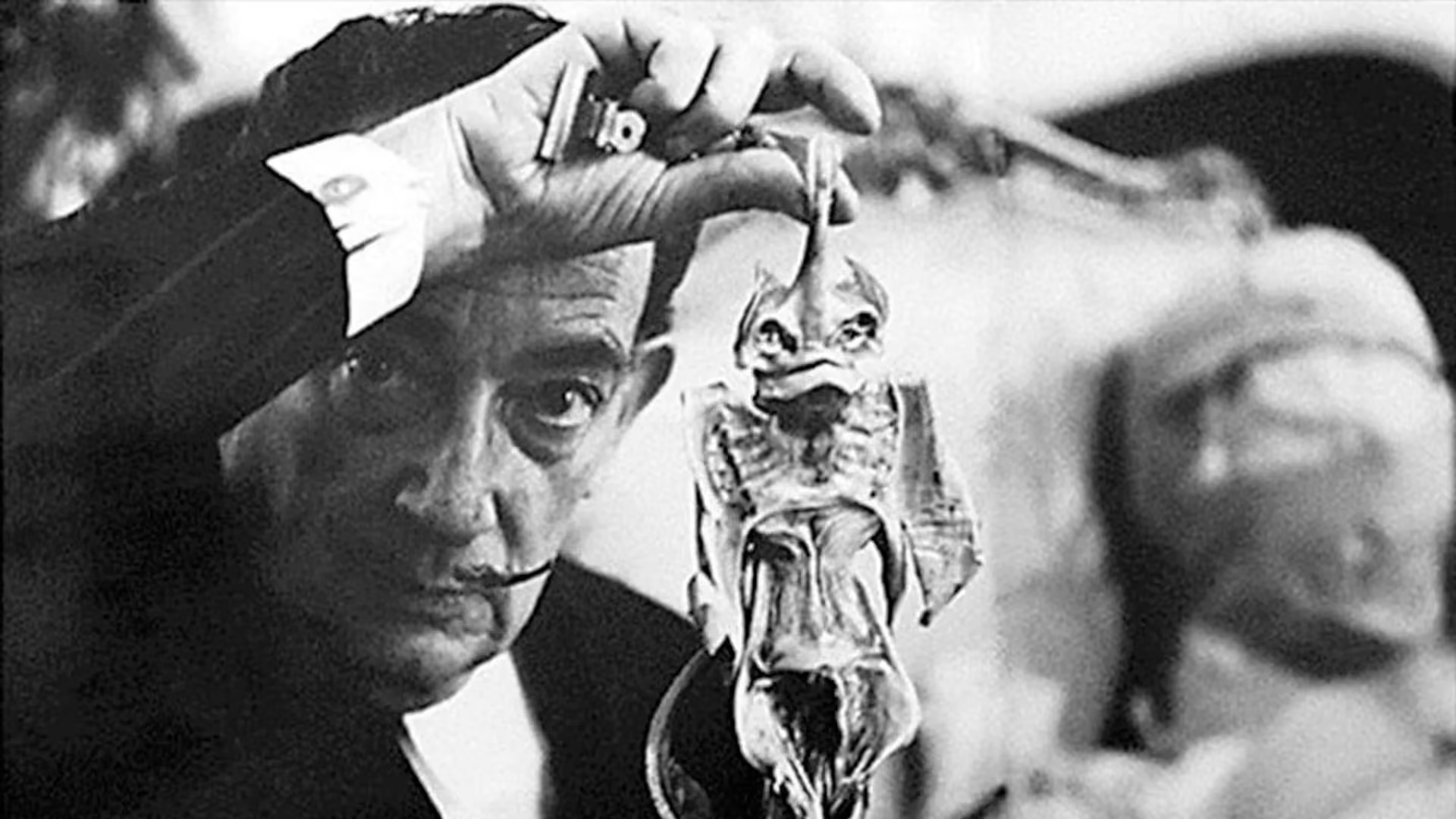
In this photo from the 1950’s, Spanish surrealist painter, Salvador Dali presents an unknown creature for our consideration while in the background, a patient recovers from surgery in a hospital bed, with head wrapped and eye bandaged.
Dali was well-known for bizarre, arresting artwork and public stunts. However, one can only wonder as to the message delivered in this disturbing photograph; what does it all mean?
Is it possible this shows the artist with the discarded remains of a Vril lizard moments after an act of Vril bodysnatching?
According to Illuminati whistleblower Donald Marshall, we share the planet with an ancient race of intelligent lizard that have occupied Earth for millions of years, known as the Vril. Marshall claims that world governments have agreed to hide the lizard’s existence, in exchange for the opportunity to utilize their natural ability to invade and steal the brain in a process that he calls bodysnatching.
Marshall explains that the process begins when the lizard ejects it’s quill, a sticky material containing the brain and spinal cord through a proboscis at the top of the head. The quill then needs to enter the eye of the victim, and from there travels to the brain, where a chemical takeover immediately begins, resulting in the complete parasitic domination of the brain. Marshall says that the human victim dies in the process and, after a period of recovery, the Vril host can return to its’ regular activities, looking, acting and seeming completely normal.
Could this image be photographic evidence of the Vril bodysnatching that Marshall contends secretly takes place in hospitals, military bases and other government facilities all over the world?
American astronomer Carl Sagan once said, “Extraordinary claims require extraordinary proof.” In order to substantiate this, we need to ask the question: Where is the proof?
Marshall explains that it would be near impossible to find any physical evidence of Vril lizards since, under the terms of their agreement with world governments, the lizards are not allowed nor are provided with any access to the surface.
However, interestingly enough, an image surfaced on the internet that Marshall claims is the partial remains of a Vril Lizard. He reports that the skull and ribcage are intact, with the proboscis at the top of the head, as well as the eye cavities, where there were eyestalks at one time. Missing, states Marshall, is the lower body, including arms and legs. He says that the wings, torso and tail seen in the video have been added.
This specimen resembles a Jenny Haviner which is, supposedly, the dried carcass of a ray or skate, stretched and modified into a bizarre creature. Several can be still be found in private collections, with one on display at the Natural History Museum in London. It’s said that long-ago sailors would create and sell these oddities as “mermaids” from far off lands, even though in their time, many believed they were the remains of miniature dragons or monsters.
Marshall explains that occasionally the carcass of a dead Vril is discovered, usually in some isolated area, as mummified remains from the past. If reported, various government agencies will immediately confiscate the specimen for “scientific research” and remove it from public view.
Aside from the lack of physical evidence, the search for any historical evidence to support the existence of the Vril will also be difficult to find since, in the past, Marshall reports the lizards have always hid in the shadows, spending their lives tunneling in deep underground caverns and caves.
However, one can find a few examples from the past, such as this apparent depiction of a Vril lizard feeding from a plant in a hand-drawn illustration from the Voynich Manuscript.
This medieval book surfaced when Wilfred Voynich purchased a collection of rare illuminated manuscripts in 1916 and discovered one volume to be entirely written in an unknown code. Now known as the Voynich Manuscript, the book consists of over 200 pages of parchment, richly illustrated with plants, stars and alchemical secrets.
In this case, one can see what has been described as a “cute little dragon” feeding in a garden. However, since the Voynich Manuscript appears to be written to preserve scientific information, one can rule out that the illustration was meant to be fanciful. Could these be instructions on what plants to grow to order to deter Vril lizards from invading your property?
Voynich brought the manuscript to eminent codebreaking experts around the world, who were unable to decipher a single word. Today the manuscript is preserved at the Yale University Library, where it remains as much a mystery as ever.
Another depiction of the lizards might be found in this authentic 16th-century English woodcut of a village witch engaged in the care and feeding of a trio of strange pets, which she stores in a cabinet for safe-keeping. Could this be a medieval representation of Vril lizards?
It remains difficult to find much physical evidence to support the existence of the Vril since Marshall claims that all references were intentionally wiped from historical record after the 1930’s.
The Ahnenerbe was a research institute in Nazi Germany whose official mission was to find new evidence of the racial heritage of the German people. Created by Reichfuhrer Heinrich Himmler in 1935, the Ahnenerbe (meaning “inherited from the forefathers”) would fund and send scientific teams all over the world, in search of the culture and history of the Aryan race.
For example, in the course of five years, expeditions were sent to study petroglyph rock carvings in Sweden, prehistoric rock inscriptions in Italy and ancient cave systems in Bavaria and France. Furthermore, members of the Ahnenerbe also seized priceless objects of historical interest from numerous exhibits throughout Europe, looting museums by the trainload. This also extended to works of scholarly interest, where witnesses claim the Nazis ravaged and seized whole libraries.
According to Marshall, many early depictions of Vril in cave paintings or rock art were destroyed, old books and manuscripts burned, as part of the agreement to hide all knowledge of the Vril from the populace.
In fact, the Voynich Manuscript was acquired as part of private collection that had been recently discovered locked in a chest in a European castle. Essentially buried for centuries, the manuscript escaped the mid-century Nazi purge. One can only wonder how many other representations of Vril lizards were destroyed in an attempt to conceal their existence from the public.
Marshall believes his mission in life is to inform the world about the ancient lizards, since he says, “no one’s going to tell you about them but me”.